Adani Foundation’s holistic agricultural interventions push for inclusive growth
Female farmers in India hold many agricultural duties, from sowing to harvesting, to allied activities like cattle rearing. And yet, their access to information and resources is restricted when compared to their male counterparts. Recent statistical data released by the University of Maryland and the National Council of Applied Economic Research (NCAER, 2018) depicts that “women constitute over 42 per cent of the agricultural labour force in India, but own less than two per cent of farmland”.
Case Study: Bridging the gender gap in agriculture:
Bridging the gender gap – from policy intervention to implementation related activities – is important to catalyse the growth in India’s agriculture sector. Bringing women working in agriculture into the mainstream can be facilitated with direct and equal access to knowledge of improved agricultural practices. In this regard, it must be noted that increasing male migration to cities often leads to feminisation of agricultural duties. Such is the story of 41-year-old Kalpana Dilip Harinkhede from Chikhali village who is one of the beneficiaries of the Adani Foundation’s training programme on Systematic Rice Intensification (SRI) – an organic farming technique which increases the yield from paddy cultivation.
Access to information about new and improved farming techniques
Chikhali is a village in Tiroda of Gondia District in the state of Maharashtra, India. Kalpana’s husband Dilip Harinkhede works as a daily wage labourer. They have two children – a daughter who is 16 years old and a son who is 15. Owning 3 acres of farmland, agriculture is the major livelihood source of this 4-member family. With Dilip being away from home for work, Kalpana handles all the work related to traditional paddy cultivation and allied activities in their farmland. She walks to her farmland daily, which is at a distance of 3 km from her residence in Chikhali. She is one of the many women farmers in India, whose day begins before sunrise and ends after sunset – tending to domestic as well as agricultural duties.
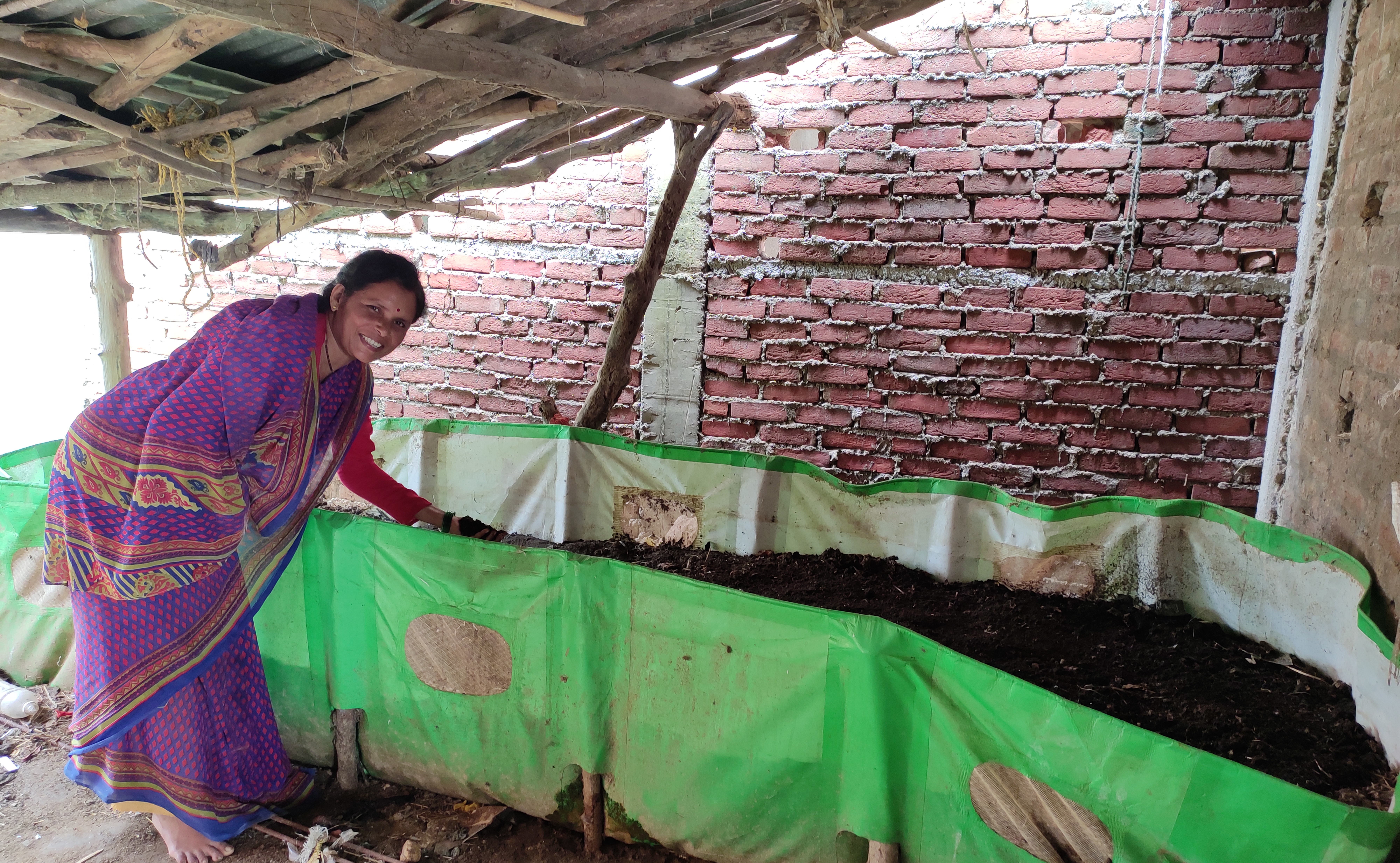
Unaware of the new and improved techniques of agriculture, Kalpana’s farming activity was digressive. Her relentless efforts found a new direction in the year 2017, when she discovered the multitude of benefits offered by SRI organic farming technique. She participated in the awareness programme held by the Adani Foundation in her village and eventually, she along with many other farmers was given a training in the SRI method. This included paddy seedling bed, transplantation, vermicomposting and making of organic pesticides like Agnayastra, Bhramastra, Dashparni ark and bio-enzyme Jeewamrut.
Complementing farming techniques with allied activities to boost productivity
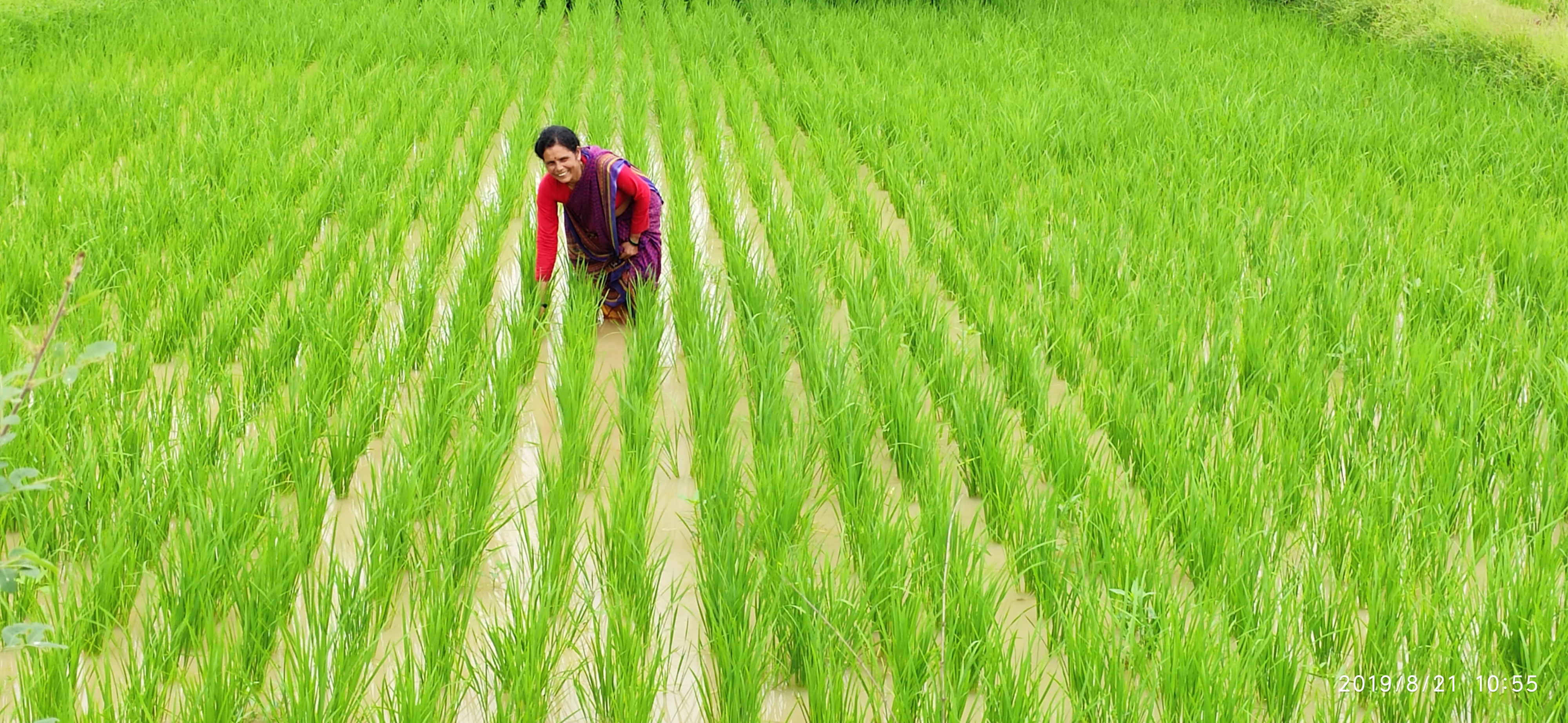
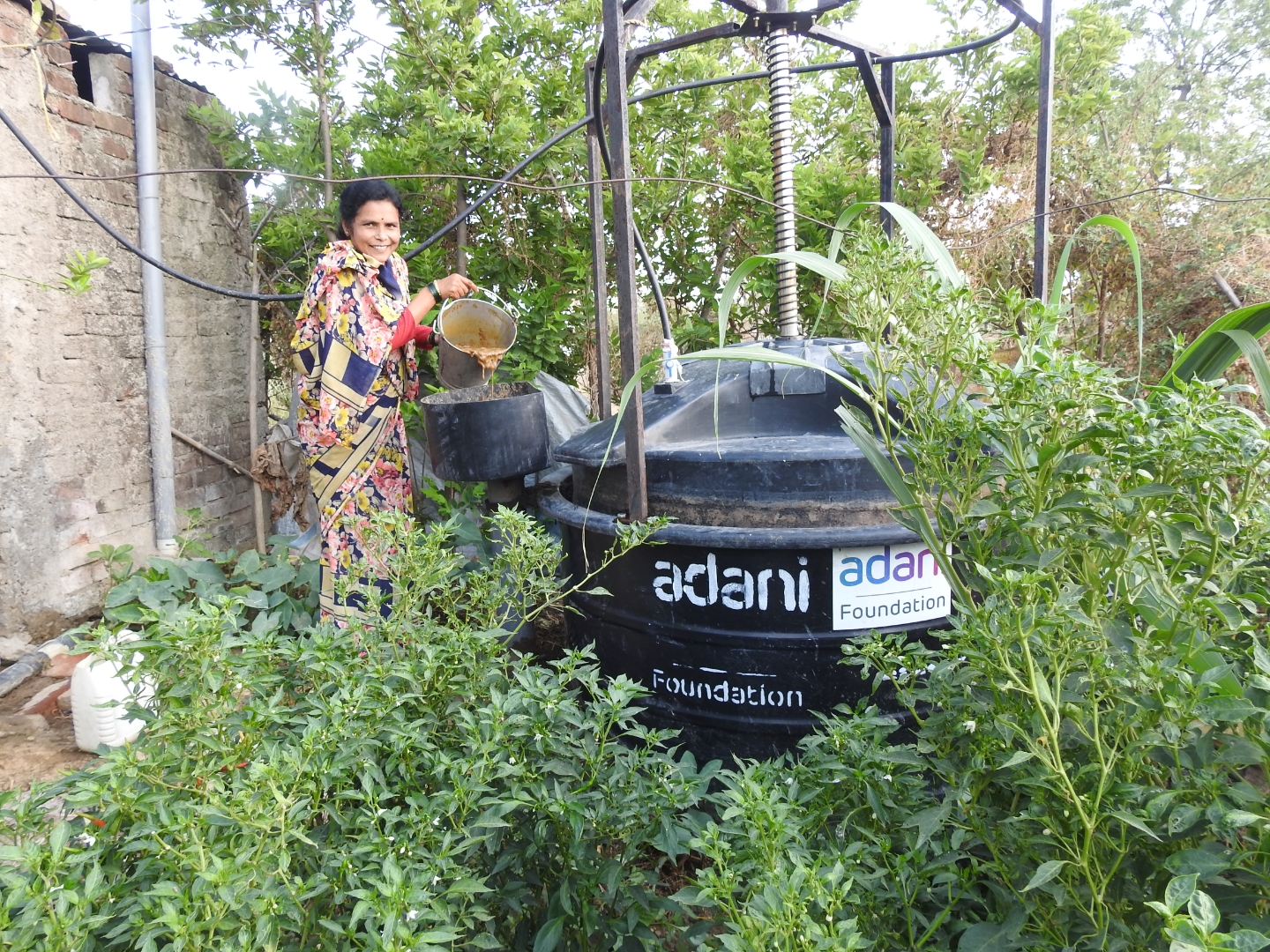
To enhance the productivity further, Adani Foundation distributed the Information, Education and Communication (IEC) material of SRI to the farmers. Equipped with knowledge, seeds, drums, Vermicompost bed, ropes, etc. Kalpana was ready to embrace the process of SRI farming. She planted paddy with the low-cost, low water, labour-intensive method taught to her on one acre of her land. Along with this organic farming technique, she learnt the pocket-friendly and environment friendly techniques of vermicomposting and producing biogas at home, the bio-gas unit of 2 CUM was given by Adani Foundation. She also planted a kitchen garden using the vermicompost which ensured healthy meals for her family.
The SRI farming in her one acre of paddy farmland, complemented with the practices of vermicomposting and using biogas for domestic purpose, reaped high rewards. In the first year itself, the rice production increased remarkably –she harvested 16-17 quintals of rice from the one-acre land, which would traditionally yield 12-13 quintals. This generated an extra income of INR 9,000 per acre as compared to the traditional method. She also saved upto INR 4,000-5,000 per acre on seeds, transplantation, labour wages and pesticides.
Making way for economic and social prosperity
With such encouraging results in 2017, she implemented paddy cultivation using the SRI technique on 2 acres of her farmland in 2018-19, reaping a total of 33-34 quintals of rice, from which she earned a total of INR 66,300. Additionally, the biogas helped her save money on LPG gas. With the money available at hand, she was able to afford electric fittings for her home and even its renovation. There was also enough money to construct a dug-well in their household. The primary improvement of increased productivity in paddy yield, led Kalpana to create improvement in other areas of her family’s economic and social life. She had set a commendable example for the larger population of her village, depicting that sustainable development is possible for those who wish to take ownership of their livelihood and living standards.
Promoting inclusive solutions at grassroots level
At Adani Foundation, we understand the significant role that women play in core farming as well as allied activities. Women in rural areas are responsible for taking care of the children and elderly, of doing the household chores and in cases like Kalpana, they also form an integral part of the agricultural labour force in small-scale and subsistence farming. Official statistics do not and cannot capture the unpaid work that they do, be it in the kitchen garden, in cattle-rearing or in the field – thereby undermining their immense contribution.
Through our role of facilitating better agricultural practices and livestock development activities across our CSR sites, we aim to empower these women, who are often invisible in the popular perception of agriculture. Our intervention with farming communities through training in organic farming techniques, allied activities and presenting alternative livelihood options like, in this region of Maharashtra the making of lac bangles, mushroom cultivation etc., lead to overall prosperity. Across all its CSR site, Adani Foundation enables the financial empowerment of women through women’s farmer producer companies, co-operatives and self-help groups. They are skilled, facilitated and empowered with resources that helps them to achieve self- reliance.
It all boils down to respecting the basic rights of women. Especially in rural India, this can become the most effective means of increasing a woman’s chance to be able to provide for themselves and their family, thereby fighting hunger and poverty in a sustainable way. If women have the opportunity to self-organise and take part in decision-making, often the whole community flourishes. By formulating inclusive approach in training farmers to adopt new and improved technique also helps boost the overall agricultural productivity in the country. Female farmers have been doing their part for many generations. It is now it is the society and country’s turn to ensure that they are given equal wages as well as equal access to information on advanced agricultural practices.
Previous Next